
Living in Slovakia: What Everyday Life Is Really Like
If you are thinking about living in Slovakia, you probably want to know what it is really like. Perhaps you have already moved and want to know more. In this article we give you practical information and share the experience of people who have been living in Slovakia for more than a year.
We will cover –
- why Slovakia is a comfortable country to move to
- what you may not like about Slovakia
- how Slovaks treat Ukrainians and Russians
- how much it costs to live here
- what food prices are like and how people shop
- how to save money while living in Slovakia.
Why Slovakia?
Our team includes a couple from Ukraine who have been living in Slovakia for over a year. They told us that when choosing a country they looked at Germany, Portugal and Slovakia. After weighing up the options they decided on a country with a Slavic culture, because it felt closer to them in language and in culture, and because it would keep them close to their native Ukraine. They also noticed that attitudes and family values in Slovakia are more like Ukrainian ones than Western European ones.
They had travelled around various European countries and lived for a while in China, but nowhere had they seen such a friendly attitude towards Russian-speaking people as in Slovakia. They also stressed that Slovakia is economically developed enough for a comfortable life.
How Slovaks treat Russians and Ukrainians.
Daria shares her impressions –
“Slovaks are a very friendly people. The first thing you notice is how welcoming and polite they are. We live in Trenčín, a lovely, cosy town at the foot of the mountains. Unlike big, more advanced Bratislava, here the habit of simply greeting strangers in the lift is still alive. Children walking towards you may politely greet the older generation as well. When saying goodbye, people you know will repeat several times “Dovidenia, majte sa, Čau, dovi”. When we talk with the Slovaks who have become our friends, we always feel at home.”
What you may not like about Slovakia🙂
It is important to understand that the pros and cons are different for everyone. And of course, living in a new country, you inevitably compare it with your home country.
For example –
- Slovakia is an unhurried country. If you are used to sorting everything out “here and now”, Slovaks do things slowly but surely. Paperwork or any other matter takes up to two weeks. The answer will reach you by ordinary post.
- Slovakia is Europe, but not entirely. If you have experience of Western Europe, Slovakia is a certain mixture of European and Soviet ways of doing things. That is neither bad nor good, it simply is. Perhaps that is part of what makes it distinctive
- Simplicity. Slovaks choose their clothes first of all for comfort, not to impress other people. That is why many women prefer trainers or flat shoes to high heels. They are not trying to “show themselves off”, they simply dress the way they like.
If you are used to buying long-stemmed roses, you will only find them in specialist florists, which are not that easy to track down. But ordinary bouquets of wild flowers, gerberas and other modest flowers are sold everywhere – in many supermarkets, for example. - Strict laws. In principle this is a very good thing, as the crime rate in Slovakia is low. For example, even where no accident has happened, a driver with 1 promille of alcohol in the blood faces a year in prison. Fines for illegal parking or speeding are also financially painful.
- Your favourite foods are not so easy to find. Slovakia does not have an abundance of seafood, caviar or seaweed, because imports are limited by cost.
- Climate. Although the climate in Slovakia is generally milder than in Ukraine, there are still fewer sunny days, which is especially noticeable in autumn and winter. There is also more rainfall, and it rains often. The difference is particularly clear in mountain regions. The sun shines and a moment later it turns to rain 🙂
If you love noisy city life and constant movement, Slovakia is more likely to mean calm, a steady pace and a country where family traditions are highly valued. As we have already said, for some that is a plus and for others it will not suit – on the whole it is a matter of taste.
How much does it cost to live here?
Let us start with the fact that “expensive” means something different to everyone.
Here is a rough monthly budget for a couple, assuming a rented flat (an important point).
Rent for a one-room flat averages 400 euros + from 20 euros for home internet (often included in the rent). A two-room flat will cost 600 and up, depending on the region. We have described where to find and rent a flat here.
Food for two people costs about 300-350 euros a month. Note that this is an average if you buy groceries including meat, but do not eat out or go for fine dining. We explain below how to save and shop more cheaply.
Health insurance.
If you do not hold temporary protection status, you will have to buy it. From 400 euros a year. You can buy it for 3, 6 or 12 months, or pay monthly from 40 euros. Commercial policies are offered by Union and AXA Assistance, for example.
Personal items – prices for clothes, household goods and the rest are more or less the same as in Ukraine.
Mobile phone service – depending on your priorities, whether you talk more or use more data, you can find a suitable tariff. For data, a good option is the operator 4sk (unlimited within the network, 16 euros/month)
A single public transport ticket in town is fairly expensive – 0.80 euro cents. A travel pass works out cheaper.
Your favourite drinks in a café – from 2.50 euros for a cappuccino.
Overall, covering all your running costs takes from 800 – 900 euros a month, give or take
Since living standards and preferences differ from person to person, this is only an average.
How to save money while living in Slovakia.
It is commonly said that a well-off person is not one who has a lot of money, but one who has enough for their needs. And if there is a way to cut your costs, why not use it?
In Slovakia almost everyone makes active use of discounts – in Slovak, Zľavy.
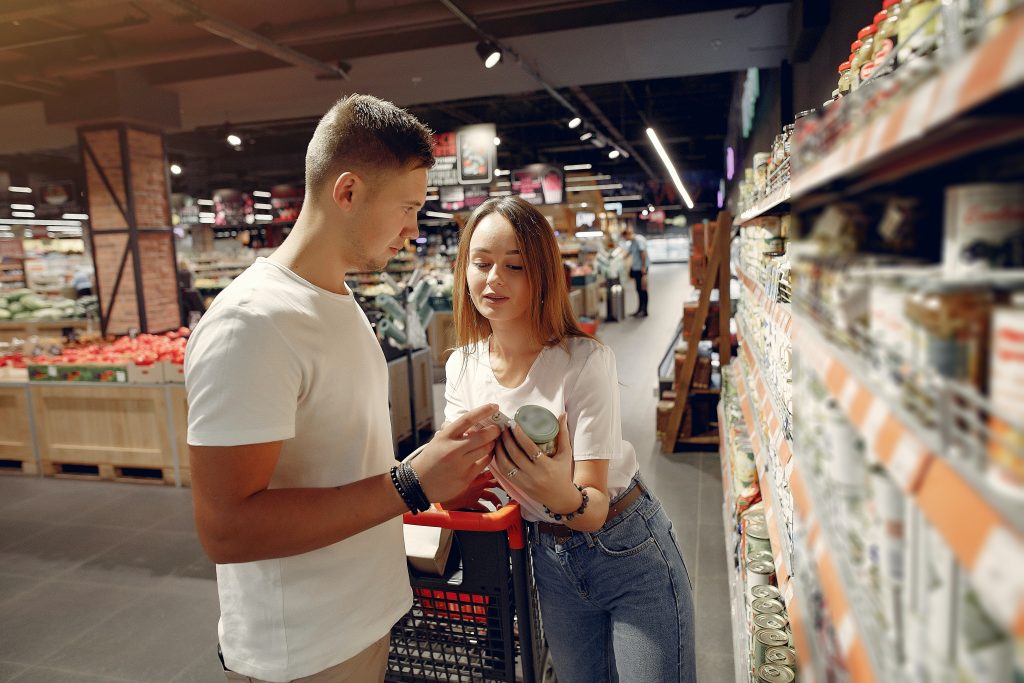
You have probably noticed how many advertising catalogues land in your letterbox. Slovaks are very sensible about what they spend on food and regularly stock up on discounted items from the leaflets.
Supermarkets run discounts that change every week. Tip – if you are planning to buy long-life groceries or household chemicals, buy them on offer to save money.
Supermarkets have not only regular discounts but also evening discounts on fruit and vegetables or baked goods. The daytime price of these items is usually the same as normal, but towards the evening they get cheaper. A couple of hours before closing the prices drop further, and half an hour to an hour before closing you can buy them at more than 70% off.
For example, in a “Lidl” supermarket a lettuce that costs €0,99 a head during the day can be bought in the evening for €0,69, and half an hour to an hour before closing for just €0,30. It is a good chance to buy essentially fresh food at a better price.
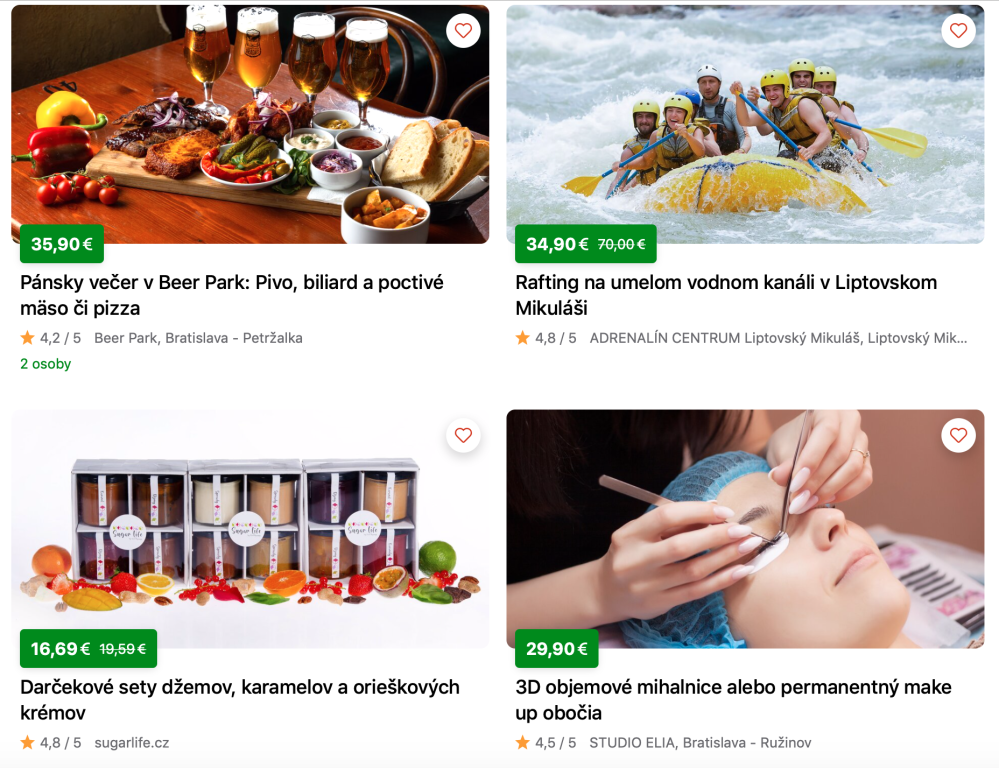
Zľavové portály – another very useful option.
These are discount websites. What is convenient is that you can browse offers and discounts by product category across all regions and subscribe to notifications about new offers in the categories you care about. They also give extra perks to regular customers (something like cashback).
The biggest one is zlavomat.sk
To find an item in online shops, you can use the product search and price comparison portal heureka.sk
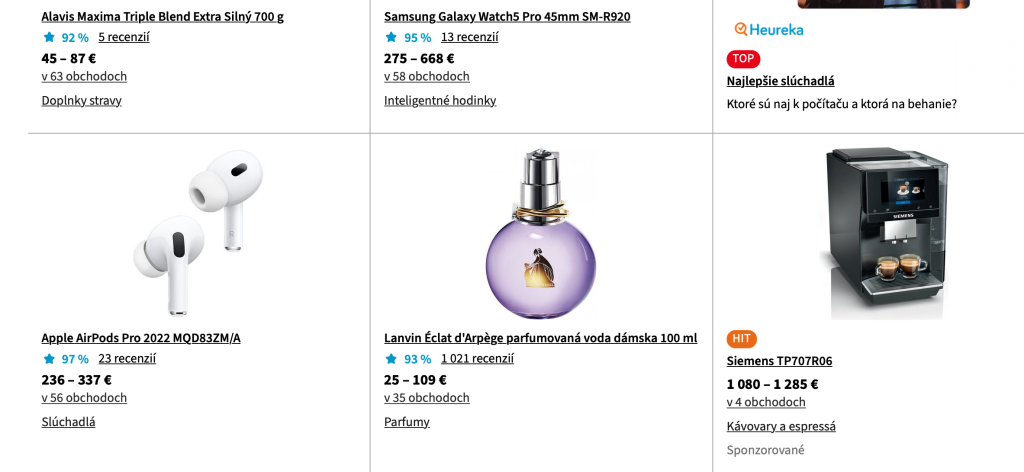
Incidentally, most online shops are listed on this portal. The Ukrainian equivalent is E-Katalog.
Food and grocery delivery
In the larger cities the habit of ordering delivery caught on quickly. Wolt operates in Bratislava, Košice, Žilina and a number of other cities: restaurants, grocery shops, pharmacies and everyday goods. The app switches to English, which helps in the first months while Slovak is still hard going.
For everyday shopping it is still cheaper to go to the shop yourself. Lidl.sk and other chains publish their weekly promotional leaflets online — a quick look before you shop saves a noticeable part of the budget.
This section contains affiliate links: if you follow them and buy something, we receive a small commission. It does not affect the price you pay.