
Moving to Slovakia 2026: The Complete Guide to Life, Work, Prices and Paperwork
Slovakia stopped being a «transit» country for Russian-speaking migrants a long time ago. People come here for the calm pace, the familiar culture, a language they can follow and prices that are still noticeably below Austrian or German ones. But moving is not only about the beautiful Tatras and coffee for 2 euros. It is paperwork, finding somewhere to live, the clinic, a school for your child and constant recalculating of whether you will have enough.
This guide is put together for people who are still at the planning stage. It has figures current for 2026, real everyday detail and links to step-by-step instructions on each topic.
In brief: is Slovakia right for you
Pros: a Slavic language (Ukrainians and Russians understand a lot within a month), Schengen, a compact country — an hour by bus from Bratislava to Vienna, relatively inexpensive healthcare and food, a calm and safe environment for families with children.
Cons: salaries are lower than in Western Europe, rents in Bratislava have risen sharply, bureaucracy is slow, and without Slovak you hit a career ceiling quickly.
Paperwork: where it all begins
Third-country nationals need prechodný pobyt — temporary residence — to live here legally. It is granted for a specific purpose, and that is the key point: a business residence permit does not give you the right to work as an employee, and vice versa. Changing the purpose later is a separate procedure.
The main options:
- Employment — the employer takes part in the process and the work permit is issued together with the residence permit.
- Business — živnosť (sole trader) or s.r.o. (the equivalent of a limited company). You need a business plan with a costing.
- Family reunification — if your spouse or parent already lives in Slovakia legally.
- Study — on admission to a Slovak university or school.
It is worth knowing about the financial requirement in advance: you have to prove funds of at least the subsistence minimum for each month of your stay. If the permit is applied for over more than a year, that is twelve times the amount, roughly 3,410 euros in the account.
The legal processing time is 90 days from the submission of a complete set of documents. In practice it can be quicker or slower: if the police ask for additional documents, the count effectively stretches out. Plan with some margin and do not buy one-way tickets before you have a decision.
A detailed breakdown of all the residence permit types is in a separate article: Types of residence permit in Slovakia. And if you are considering the business route, we have a step-by-step guide: živnosť (SZČO) in Slovakia.
Work and salaries
From 1 January 2026 the minimum wage in Slovakia is 915 euros gross per month (5.259 euros an hour). This is the largest jump on record: 99 euros more than in 2025. The average salary across the economy is around 1,524 euros gross.
The key word here is «gross». What reaches your account is noticeably less: from 2026 the health insurance rate for employees rose by 1 percentage point to 5%, on top of social contributions and income tax. As a rough guide, 1,500 euros gross means about 1,150–1,200 euros in the bank.
Rather than working it out by hand, see our explainer: Gross and net salary — how to calculate your earnings correctly.
Where to look for work. The main job boards are Profesia.sk, Kariera.sk and Indeed. For Russian speakers without Slovak, the realistic niches are IT and development (English is usually enough), logistics and warehousing, manufacturing, hospitality, the beauty sector and construction. International companies in Bratislava often work in English.
An honest word about the language. You will get through the first months on a mix of Russian, Ukrainian and English. But at the level of «doctor, school, bank, tenancy agreement» you need Slovak. The good news: for Slavic speakers it is one of the fastest languages to pick up — a basic everyday level is genuinely achievable in 3–6 months.

Housing: the heaviest item in the budget
This is the point where expectations most often part company with reality. Rents in Bratislava rose sharply in 2026.
The average rent for a flat in Bratislava has passed 1,100 euros a month excluding utilities — a rise of about 17% over the year. A two-room flat including utilities costs around 917 euros on average; outside the Old Town it is realistic to find options in the 850–900 euro range including utilities. New builds cost more — around 1,237 euros excluding utilities, older stock about 1,021 euros.
In the regions the picture is fundamentally different. In Košice, Žilina, Nitra, Prešov and Banská Bystrica a two-room flat often comes in at 450–650 euros including utilities. If your job allows remote working, that is a huge saving.
What to know about a tenancy agreement:
- The deposit is usually one or two months’ rent.
- Many landlords ask for proof of income or an employment contract.
- Check whether utilities are included in the price — the wording «bez energií» means utilities are on top.
- You also need the contract to register your address when applying for residence.
People mostly look for housing on Nehnutelnosti.sk, Reality.sk, Bazos.sk and in Facebook groups. Many buy furniture and appliances for their first flat second-hand — it is appreciably cheaper: Online marketplaces in Slovakia.
If you are planning to buy, rates and conditions are covered here: Mortgages in Slovakia.
What life really costs
Inflation in Slovakia remains among the highest in the eurozone — in April 2026 it accelerated to 3.9%. The main pressure comes from housing and energy: that segment rose 6.3% over the year, heating by almost 28% and gas by 6.7%. Food, meanwhile, has in places even become cheaper.
A rough monthly budget:
- A single person in the regions: 800–1,100 euros
- A single person in Bratislava: 1,200–1,600 euros
- A family of three in Bratislava: 2,000–2,700 euros
What that is made up of:
- Food for one person — 250–350 euros a month. Lidl and Kaufland are cheapest, Billa and Tesco Express more expensive.
- Utilities for a flat — 100–200 euros a month depending on the season and the heating.
- Internet — 15–25 euros, mobile — 10–20 euros.
- Lunch in a café — 8–12 euros, a set lunch in a canteen — 6–8 euros.
- Travel in Bratislava — from 1.09 euros a ticket, a monthly pass around 30 euros.
Details on transport, fares and buying tickets are in a separate article: Public transport in Bratislava.

Healthcare
The health system is built on compulsory insurance. Three insurers provide public insurance: Všeobecná zdravotná poisťovňa, Dôvera and Union. You can choose any of them — cover for basic services is the same, what differs is the service and the additional programmes.
If you are formally employed, contributions are paid automatically: 5% from the employee and 11% from the employer. An important detail for new arrivals: after receiving a residence permit for employment you first register with the insurer yourself, and only then does the employer register you as a member of staff.
People on a živnosť pay their contributions themselves. And until you have residence and a job you need commercial health insurance — it is required when you submit your application.
How it works in practice: you sign up with a family doctor (všeobecný lekár) where you live. They are the entry point to the system: you reach specialists on their referral. You can also book a specialist directly, but the appointment will be paid. The ambulance service is 155, the single European number is 112.
Dentistry is paid almost everywhere, even with insurance: a scale and polish is 40–70 euros, treating a cavity from 60 euros.
Children: nurseries and schools
Pre-school education from the age of 5 is compulsory in Slovakia. State nurseries (materská škola) cost a token amount — usually 20–50 euros a month plus meals. The problem is not the price but the places: in Bratislava and the larger cities the waiting lists are long, and applications are made in spring, several months before September.
School is free and compulsory from the age of 6. Foreign children are enrolled regardless of their level of Slovak, and schools run language courses to help them settle in. Most families’ experience: a child under 10 catches up with the language within one school year, teenagers find it harder.
There are private and international schools teaching in English — from 300 to 900 euros a month.
Banks and money
You can open an account with a passport and proof of address — full residence is not always required, though conditions vary between banks. The main players are Slovenská sporiteľňa, VÚB, Tatra banka, ČSOB and 365.bank. Account maintenance runs from 0 to 8 euros a month.
Many newcomers start with Revolut or Wise: the card arrives within a couple of days, with no trip to a branch. But for salary, rent and utility payments a local IBAN is more convenient — some employers and landlords do not accept foreign accounts.
Card payments are accepted almost everywhere, including small shops and public transport. Keep cash for markets and rural areas.
Transport and getting around
Public transport is well developed. Bratislava has trams, trolleybuses and buses, with tickets from 1.09 euros. Between cities there are ZSSK trains and RegioJet and Slovak Lines coaches; Bratislava to Košice by train takes about 5 hours.
A pleasant bonus of the geography: Bratislava to Vienna is an hour by bus, to Budapest 2.5 hours, to Prague 4 hours. Many people use Vienna’s Schwechat airport, which is closer than Bratislava’s for most destinations.
Driving licences: licences from Ukraine and most CIS countries have to be exchanged for Slovak ones. EU licences are valid without exchange.
Everyday life, shopping and settling in
The big chains are Lidl, Kaufland, Tesco, Billa and Terno. For appliances and electronics — Alza, Datart, Nay. For furniture — IKEA, JYSK, Möbelix. We have put together a round-up of tried and tested online shops here: Top 7 online shops in Slovakia.
What to know about the rhythm of life: shops are often closed on Sundays or keep shorter hours, the lunch break in government offices is sacred, and it is better to book appointments with the doctor, the bank and the foreign police online in advance.
Slovaks in everyday life. Reserved, polite, without any show of emotion. They keep their distance for longer than we are used to, but once a connection is made it is dependable. Attitudes towards Ukrainians are generally friendly and the language barrier is minimal.
To get up to speed with the country faster, it is worth reading the local news — a selection of reliable sources: Which Slovak news sites are worth reading.
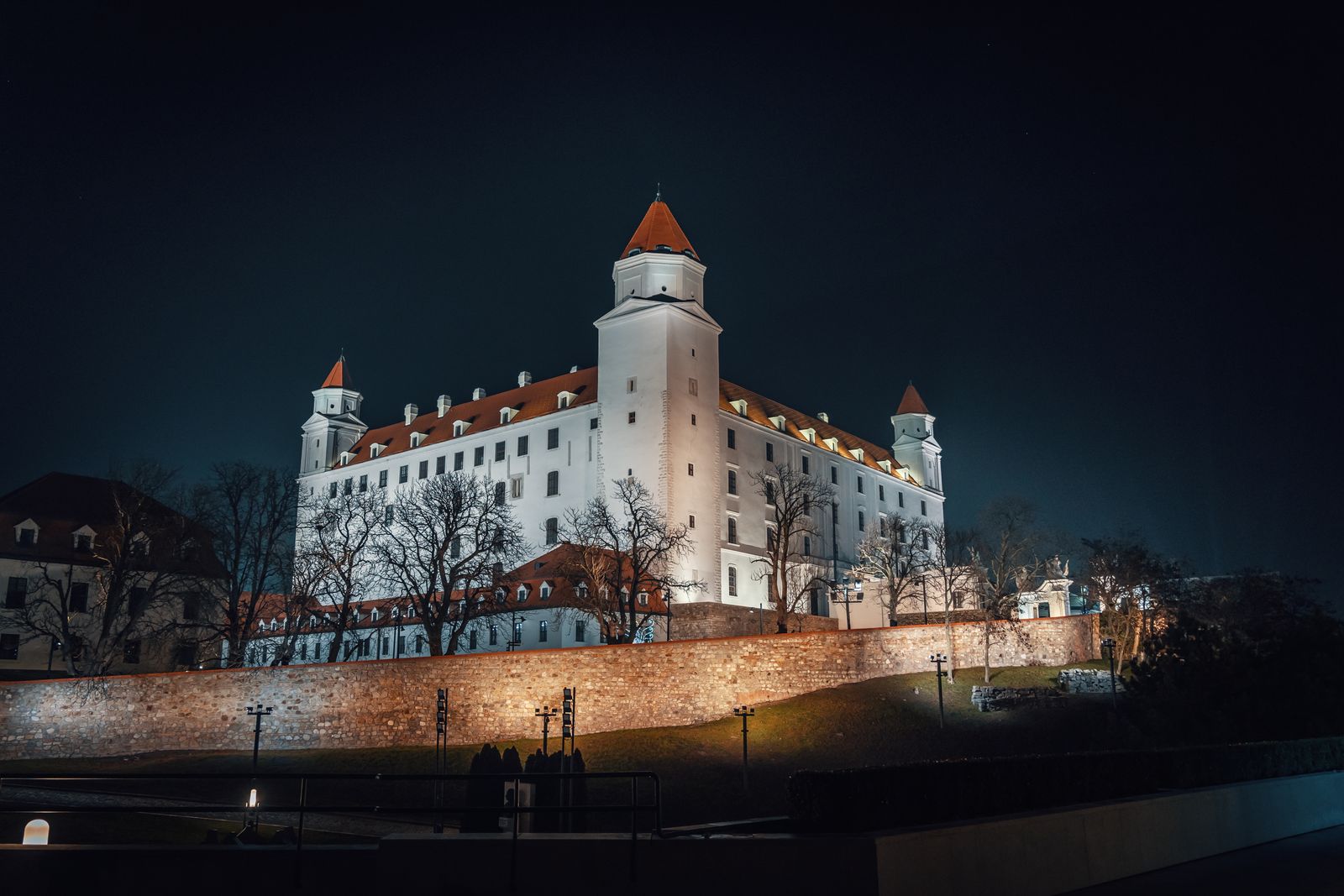
And for weekends Slovakia really is good: mountains, thermal baths and castles an hour’s drive away. Ideas for your first trips: A day trip from Bratislava and Summer pools and beaches in Bratislava.
An action plan: the first steps
- Decide the purpose of your stay — work, business, family or study. The whole set of documents depends on it.
- Gather your documents in advance. A criminal record certificate, education documents, birth and marriage certificates — with an apostille and a sworn translation into Slovak.
- Prove your finances — around 3,410 euros in the account for an application covering more than a year.
- Take out health insurance for the period before you receive residence.
- Find somewhere to live and get a tenancy agreement — you need it to register your address.
- Submit your documents to the foreign police department and allow up to 90 days for processing.
- After you receive residence: register with an insurer, open an account, sign up with a doctor, enrol the children in nursery or school.
Is it worth moving
Slovakia is a good choice if you are looking for a calm European country with a language you can follow, no vast metropolises and costs below Western European levels. It is comfortable for families with children and for anyone who values access to nature.
It suits you less well if your priority is maximum income. Salaries here are lower than in Germany or Austria, while rents in Bratislava have caught up with their level over the past year. Many people settle on a compromise: living in the regions and working remotely, or moving to Bratislava only for a specific job offer.
The main piece of advice: do not try to solve everything at once. Documents, housing, the language and work are four separate processes, and each takes longer than it seems at the start.
If at some stage you need help from a Russian-speaking lawyer, accountant, doctor or estate agent, we have a directory of contacts: Russian-speaking specialists and services in Slovakia.
See also
- Types of residence permit in Slovakia
- živnosť in Slovakia
- Gross and net salary in Slovakia
- Russian-speaking specialists and services
Not sure which district to look in? A breakdown of every Bratislava district with prices is in the article which district of Bratislava to live in.
Children are a separate topic once you have moved: read how to enrol a child in school or nursery in Slovakia and what the deadlines are.
One of the first steps after moving is arranging insurance: how much health insurance in Slovakia costs and which one suits you.
If you plan to drive, add insurance to the list too: PZP is compulsory for every registered vehicle.
If you are expecting an addition to the family, our detailed article on pregnancy and childbirth in Slovakia will be useful: doctors, insurance and cash benefits.
If you are planning your own business, there is a separate guide to registering a company in Slovakia: share capital, fees and timescales.
When you are setting up your new home, do not forget insurance: in a separate article we explain the difference between buildings insurance and household contents insurance and which one a tenant should choose.
Planning to travel from your new base? A guide to how to arrange travel insurance before a trip from Slovakia will help: what it covers and how much it costs.
If you have come from outside the EU, start with the key document: how to get a work permit in Slovakia — the types of permit and the application process.
Setting up your home after the move
Rented flats in Slovakia usually come furnished, but the basics — bed linen, kitchenware, towels, lamps — are generally missing. Buying them online is the cheapest option.
4Home.sk — textiles, kitchenware, small appliances and household bits and pieces. HomePoint.sk — furniture and interior items, including inexpensive wardrobes, shelves and tables. Kitos.sk — kitchen equipment and cookware, including professional ranges.
If you are planning renovations, or even just repainting the walls, eFarby.sk will come in handy — paints, varnishes and decorative plasters with delivery across the country. But remember: in a rented flat any changes have to be agreed with the owner in writing, otherwise they may be deducted from your deposit when you leave.
This section contains affiliate links: if you follow them and buy something, we receive a small commission. This does not affect the price you pay in any way.
Who runs this site and how we prepare our articles is explained on the «About us» page.